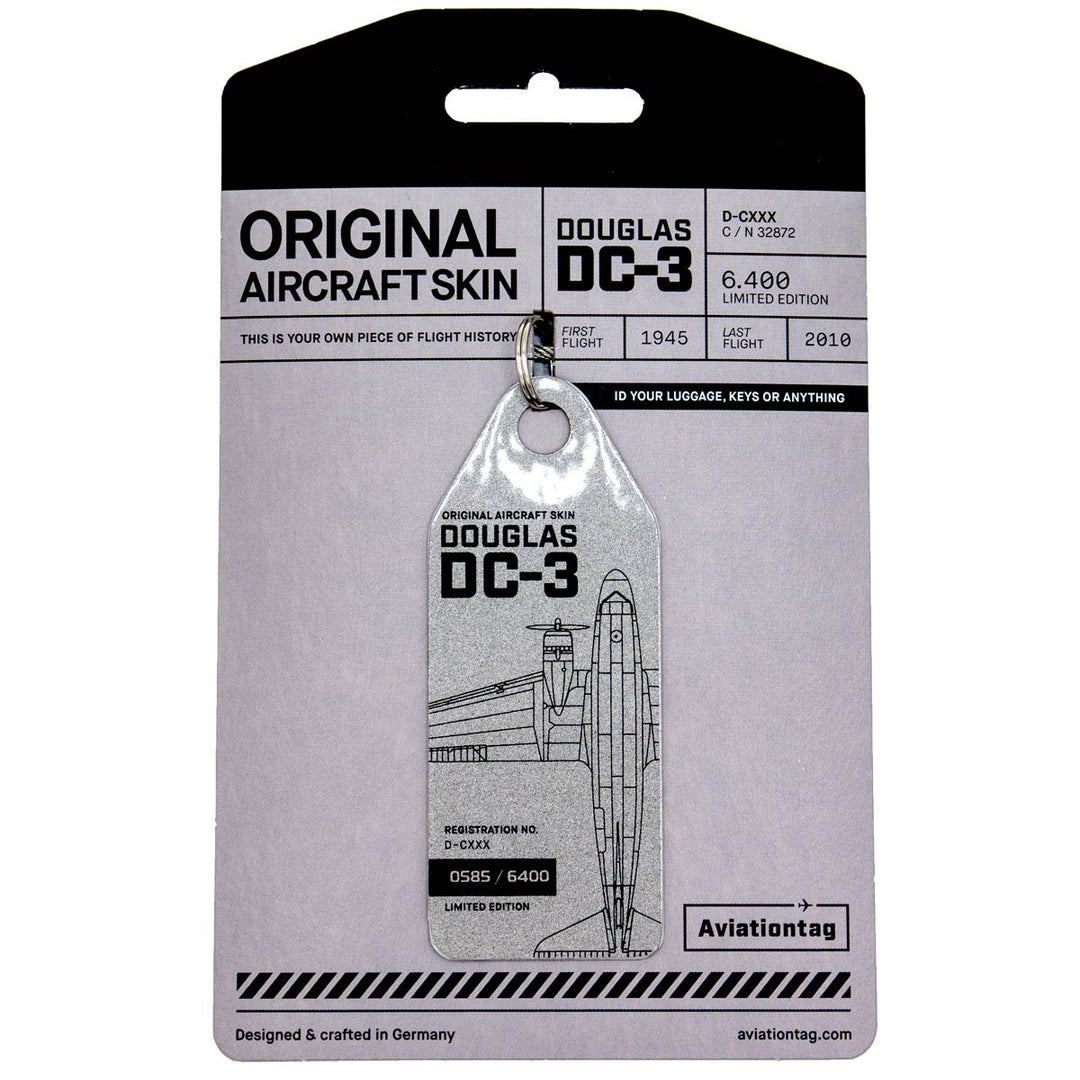


Aviationtag has turned many remarkable aircraft into collectible pieces of aviation history over the years. Among them were civilian airliners, regional workhorses, historic freighters, military transport aircraft, reconnaissance aircraft, helicopters, and even aircraft with humanitarian or special-mission backgrounds.
But one category had never been part of our story before: a true fighter jet.
With the McDonnell Douglas A-4 Skyhawk C-FGZO, that changes. Created in official cooperation with Top Aces, this edition marks Aviationtag’s first step into the world of fighter jet heritage — compact, fast, tactical, and very different from the passenger aircraft most people associate with aviation collectibles.
And the story behind it is unusual even by Aviationtag standards. The aircraft itself is still active. Instead of material from the fuselage, this edition was made from original external fuel tanks — drop tanks — connected to a still-flying A-4 Skyhawk.

The aircraft behind this edition is the McDonnell Douglas A-4N Skyhawk C-FGZO, identified by the number 532 and built in 1976. Today, C-FGZO flies with Top Aces, a company specializing in tactical air training and adversary air services.
Before its Top Aces chapter, the aircraft belonged to the global operational story of the A-4N Skyhawk, including service history with the Israeli Air Force. For this blog, that is best understood as one chapter in a much wider aviation story: the A-4 Skyhawk was operated around the world, adapted for different missions, and kept relevant long after many aircraft of its generation had disappeared from frontline or training use.
In its current role, C-FGZO represents a particularly fascinating kind of aviation longevity. This is not a retired aircraft sitting quietly in a museum corner. It is a jet that continues to fly, train, and perform in a modern tactical aviation environment.
That is one of the reasons this Aviationtag edition feels so different. It does not just preserve a piece of the past. It connects collectors to an aircraft type that still has a role in the air today.
This Douglas A-4 Skyhawk was designed in the early jet age as a compact, carrier-capable light attack aircraft. Its first flight took place on 22 June 1954, and the type entered service in 1956. Production continued until 1979, with nearly 3,000 aircraft built.
Those numbers only tell part of the story. What made the Skyhawk remarkable was its design philosophy. It was not built around excess size or complexity. It was built around focus: low weight, compact dimensions, strong performance, and rugged operational capability.
Originally developed as a carrier-capable light attack aircraft for the U.S. Navy and Marine Corps, the A-4 Skyhawk became closely associated with aircraft carrier operations and naval strike missions. During the Vietnam War, A-4s flew some of the first U.S. strikes after the Gulf of Tonkin incidents in August 1964 and went on to log more combat missions over Vietnam than any other U.S. naval aircraft, according to the National Naval Aviation Museum. The type also saw major operational use with other air arms, including during the Yom Kippur War and the Falklands War, underlining how widely the Skyhawk served beyond its original U.S. Navy role.
That is why the A-4 remains such an icon among aviation enthusiasts. It has presence without being enormous. It has history without needing decoration. And in the air, it still looks exactly like what it was designed to be: purposeful.


The A-4 Skyhawk’s story did not end with its original military service. Like many highly capable aircraft, it found a second life in training and aggressor roles. These missions require aircraft that can reliably simulate certain threat profiles, provide realistic training value, and operate in demanding environments.
That is where the Skyhawk’s design continues to make sense. A compact, agile jet with proven handling characteristics can still be highly useful in the right training scenario. The type’s long service life is not only a matter of nostalgia; it is a sign of how effective the original concept was.
For Aviationtag, this makes the A-4 particularly interesting. We have preserved material from many aircraft that completed their commercial or operational lives. But C-FGZO belongs to a different category: a fighter jet connected to active tactical training.
This edition was created in official cooperation with Top Aces, one of the world’s leading providers of contracted adversary air and advanced airborne training. The company was founded in 2000 by former fighter pilots and describes itself as a global leader in adversary air and JTAC training services.
Top Aces operates specialized aircraft to support military readiness training. Its mission profiles include adversary support, “Red Air” training, Joint Terminal Attack Controller training, electronic warfare training, missile simulation, profile simulation, and other advanced airborne training tasks. The company lists the Douglas A-4N Skyhawk as a proven platform for multiple mission profiles.
For many aviation fans, this is the closest real-world equivalent to the kind of elite fighter training made famous by popular culture — only without the movie set. This is operational training, flown by experienced aviators, using real jets for real military training needs.
That connection gives the C-FGZO edition a very specific character. It is not only about the A-4 Skyhawk as a historic aircraft type. It is also about the aircraft’s continuing relevance in a modern training environment.

Most Aviationtag editions begin with an aircraft that has reached the end of its flying life. The material is recovered, carefully processed, cut, engraved, and transformed into individual Aviationtags. The aircraft no longer flies, but part of its story continues in the hands of collectors.
The A-4 Skyhawk C-FGZO edition follows a different route. Because the aircraft is still active, the material for this edition comes from original external fuel tanks — commonly known as drop tanks — rather than from the aircraft’s fuselage.
Drop tanks are external auxiliary fuel tanks carried by aircraft to extend range or endurance without permanently adding weight or drag to the airframe. Once the extra fuel is no longer needed — or if the aircraft has to reduce weight and drag quickly — they can be jettisoned


At its core, Aviationtag is about giving aircraft material a second mission. Sometimes that material comes from a legendary airliner. Sometimes from a regional aircraft, a freighter, a helicopter, or a military platform. With the A-4 Skyhawk C-FGZO, the idea expands into a new category.
This is our first fighter jet Aviationtag.
It brings together several layers of aviation history: a legendary aircraft type designed in the 1950s, a specific airframe with decades of service behind it, a modern Top Aces training role, and an unusual material source in the form of original drop tanks.
For collectors, that makes this edition more than just another aircraft tag. It is a piece of fighter jet heritage with a direct link to active aviation.
The McDonnell Douglas A-4 Skyhawk was never about excess. It was about performance, agility, and purpose. In Aviationtag form, that character remains visible: compact, distinctive, and unmistakably connected to the faster, louder, more tactical side of aviation history.
A new category has taken off.
Which military aircraft should become an Aviationtag next — and why? Tell us in the comments below.
One thing is certain: our first fighter jet edition will not be the last step into this side of aviation history!